
Summary. A successful prototype shows that a design can work, but it does not prove the product can be made consistently, economically, and on schedule. Before production, the customer and manufacturer must align the approved design with controlled drawings and specifications, a repeatable production sequence, material availability, and clear quality standards. They also need to consider how tooling, tolerances, sourcing, and lead times affect cost and delivery. For complex products, a pilot run can test these assumptions across units and reveal recurring issues before they reach full production. Resolving these questions early reduces the risk of rework, delays, and unexpected costs. The steps between the first build and the first major order connect product design to dependable delivery. Read the full article to see how production readiness comes together.
A prototype answers an important question: Can this design work?
The first build turns a product concept into something physical, where components, materials, and assembly methods can finally be tested together. It’s a major and exciting milestone. But a successful prototype does not guarantee that the product can be built consistently and cost-effectively.
Getting there takes more than repeating the first build. The design, documentation, materials, equipment, and quality requirements need to work together as one coordinated process.
That work happens in the stretch between prototype approval and the first large order. During that time, the customer and the manufacturer work together to develop a production process capable of delivering the same result on every unit.
Here’s how it plays out.
What Documentation Is Needed Before Production Begins?
Before production begins, the approved product needs to be fully defined in its drawings, models, bill of materials, specifications, and revision history. All of those records need to match the prototype that was approved.
A prototype build teaches the team things the original design documents can’t always reveal. For example:
- A part needing a slight adjustment to fit.
- A fastener turning out to be difficult to reach during assembly.
- A substitute component keeping the build moving while the specified one is unavailable.
Discoveries like these are a normal and valuable part of product development. They become production risks only when they reside in people’s not-so-perfect memories or in informal notes instead of being documented in the controlled design.
A complete product definition establishes exactly what the manufacturer is expected to build, and every function relies on it.
Purchasing gets a reliable basis for sourcing materials.
Production gets a consistent reference for fabrication and assembly.
Quality gets a clear standard for inspection.
If any of those records describe a different version than the approved prototype, production begins with incorrect and conflicting information. A good way to eliminate this risk is to ask, Could someone who never saw the prototype build the same product using only the documentation?
If the answer is yes, the product is properly defined.
How Is the Manufacturing Process Planned?
The manufacturing process is planned by mapping how the product will flow from raw material to finished unit, including the sequence of operations and the tooling and fixtures needed to build every unit the same way.
Building one prototype and building the same product repeatedly are different tasks. A prototype is often assembled with extra attention, hand fitting, and small adjustments that would be too slow or too inconsistent across a larger order.
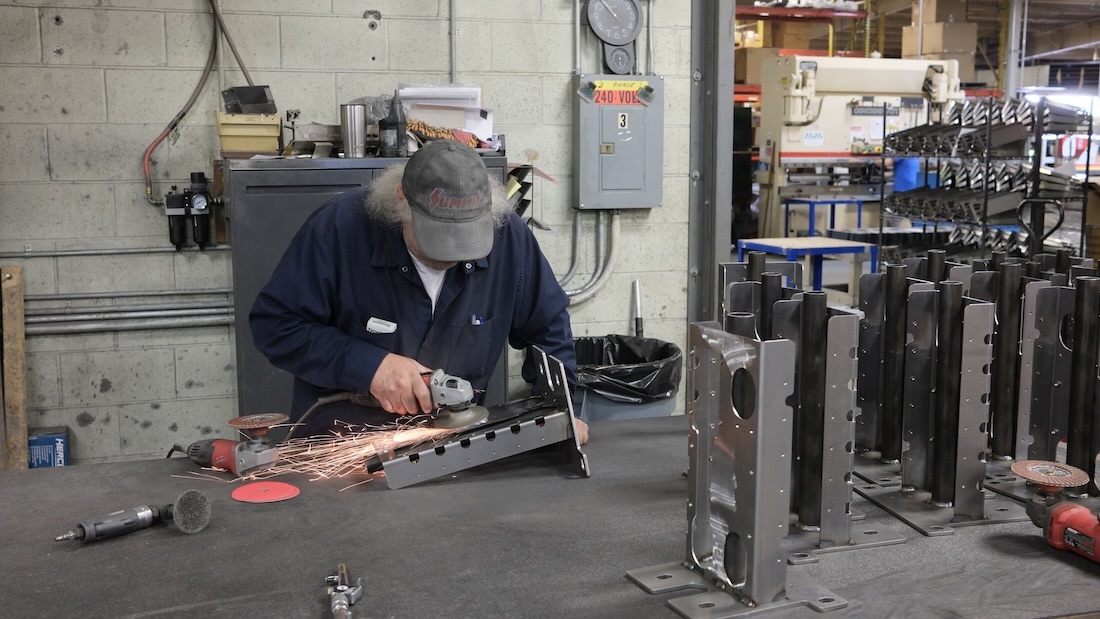
Take a sheet metal enclosure as an example. Its production may involve cutting, forming, welding, finishing, and assembly, and the order of those operations matters. Sequence can affect part dimensions, distortion, tool access, and how consistently components go together. A fixture can hold parts in the same position during welding or assembly every time, which reduces variation from one unit to the next.
Design and process decisions also influence each other. A tight tolerance may protect a critical fit, but an unnecessarily tight one adds inspection and manufacturing effort without improving function. Production needs can influence the design as well. A change to a bend, weld, or mounting feature may simplify production, as long as it preserves the product’s intended performance. This is why early conversations between the customer’s engineers and the manufacturer are so important. Small design adjustments are far easier to make before committing to tooling and materials.
The result of this phase is a production process that connects the approved design to the work that people and equipment will perform. It defines how parts move through the shop and shows where setup, tooling, or special handling will affect time and cost.
How Do Materials and Lead Times Affect the Production Schedule?
Materials and lead times often set the pace of a production schedule, because a product cannot be completed until every material and purchased component has arrived.
Prototype quantities are usually small enough to pull from available stock or to cover with expedited purchases. A larger order changes the picture. Material grades, thicknesses, finishes, hardware, electronics, and other components all need to be available in the required quantities and at the right time.
For that reason, a production plan covers more than internal fabrication. It also accounts for:
- Supplier lead times
- Minimum order quantities
- Approved alternatives
- Outside processes such as painting or plating
A single long-lead component can determine when the full assembly is ready, even when every fabricated part is already complete.
This is also why cost and delivery estimates depend on assumptions about quantity, sourcing, and order frequency. Sharing a realistic forecast, even a rough one, helps the manufacturer plan purchases and capacity.
It also explains why late design changes can send a project sideways. If the design changes after components have been purchased, the impact reaches well beyond engineering. It can lead to excess inventory, added cost, or delays while revised parts and materials are secured.
How Are Quality Requirements Defined for Production?
Quality requirements are defined by turning customer expectations into specific, measurable acceptance criteria for the characteristics that affect fit, function, safety, and appearance.
Prototype approval is often based on a working sample and a shared understanding of customer expectations. Repeatable production requires that understanding to be precise, because the people building and inspecting the product need to know exactly what to check and what counts as acceptable.
Some requirements are dimensional, such as the location of mounting holes or the alignment of a door. Others address weld appearance, finish quality, component placement, wiring, or performance during a functional test. Together, these criteria determine what gets inspected, how it is measured, and what records accompany the finished product.
Subjective characteristics require particular attention. For example, “good cosmetic finish” can mean different things to different people, so it helps to agree on a reference sample or a written standard before production begins.
Clear acceptance requirements also identify where work should be checked in the process. Catching a dimensional issue before finishing or final assembly is usually far simpler than discovering it after the product is complete. Good quality planning matches each requirement to the stage of production where checking is most beneficial.
What Is a Pilot Run, and When Is One Needed?
A pilot run is a limited production build that tests the planned process under conditions closer to full production. It shows whether the drawings, materials, tooling, work sequence, assembly methods, and inspection requirements work together as expected. A pilot run is most valuable when the product is complex, the process is unfamiliar, the order is large, or a defect would carry serious consequences.
A pilot can reveal issues that a single prototype never could. Across several units, the team may notice:
- Inconsistent alignment
- Excessive adjustment
- Longer cycle times than expected
- Recurring rework
Findings like these help separate an isolated prototype problem from a process issue that would jeopardize the larger order.
When the results of a pilot meet the agreed requirements, the team can have greater confidence in the assumptions behind cost, capacity, and delivery. When they fall short, the process can be adjusted before the problem is repeated across many more units.
Not every product or order needs the same level of pilot activity. The right amount of validation depends on:
- Product complexity
- Familiarity with the process
- Order quantity
- The consequences of a defect
A simple bracket built with familiar methods may need very little, while a complex electromechanical assembly may warrant a more formal run. In every case, the goal is the same: confirm that the planned process can consistently produce acceptable units.
Repeatability Connects Design to Delivery
Moving from a prototype to a large production order involves much more than increasing the quantity.
- The product definition needs to match the approved design.
- The manufacturing method needs to support consistent work.
- Supply plans need to align with the schedule.
- Quality criteria need to make acceptance clear.
These elements also depend on one another:
- A drawing revision can change material needs.
- A material substitution can affect fit or finishing.
- A process change can alter inspection requirements or production time.
Production readiness comes from working through those relationships early, before they turn into unwelcome and costly surprises in the middle of an order.
That is why the time between the first build and the first big order is so valuable. Questions answered during this stage cost far less than problems discovered after a full order is underway.
A successful prototype demonstrates that the design can work. A validated production process establishes how the product can be made repeatedly and delivered with predictable results.
__________________________
About Mathison Manufacturing
Founded in 1959, Mathison Manufacturing is a trusted partner in precision contract manufacturing, specializing in tight-tolerance sheet metal fabrication, electromechanical assemblies, and complex, high-end solutions. Known for exceptional craftsmanship, responsive service, and a customer-first mindset, Mathison is dedicated to delivering quality products and building lasting partnerships that help customers grow.
Let’s work together on your next project! Contact us today!